The Quick Verdict
If you're sending occasional newsletters to a small list and have no plans to grow beyond that, Mailchimp's simplicity is genuinely appealing and its entry-level pricing has been hard to beat (ActiveCampaign does beat it!). But if you've ever felt like your marketing platform is holding you back, if you're doing workarounds to segment your audience, if you're manually managing follow-ups that should be automated, or if you've been burned by emails landing in spam, then you've likely already outgrown Mailchimp without realizing it.
At a glance
The Deliverability Gap Nobody Talks About Enough
Here's the thing that surprised us most when we went through the independent data: deliverability isn't close. In the most recent tests run by EmailToolTester, an independent testing organization that sends real campaigns to real inboxes, ActiveCampaign achieved a 94.2% deliverability rate. Mailchimp came in at 89.5%.
Ranked #1
EmailToolTester, 2025
That 4.7 percentage point difference might not sound dramatic, but do the math on your list. If you're sending to 10,000 contacts, that's roughly 460 more emails actually landing in inboxes rather than spam folders or going missing entirely. Scale that up over a year of campaigns and you're talking about thousands of customer touchpoints evaporating because of infrastructure differences between the two platforms. When we looked at the customer stories, this showed up as the most cited reason businesses made the switch.
"Mailchimp was easy to use, but our deliverability rates were just so awful. ActiveCampaign's inbox receive rates were way better. There were a bunch of factors that y'all were taking into account that other email providers just weren't. So we switched."— Nyk Rayne, Director of Operations, UN|HUSHED
UN|HUSHED isn't an outlier in our research. Palmetto Fortis saw their open rates jump from 22% to 52% after switching. Parrish Law went from 17–19% to consistently 35–40%. The Museum of Science & Industry Chicago reported 206% revenue growth year-over-year, strongly supported by their email marketing after switching. That's not coincidence — that's what happens when your emails actually get delivered.
ActiveCampaign also sends through its own private network rather than the public internet, which means emails don't compete with general web traffic. The result is delivery that's reportedly up to 10x faster and more reliable. They also offer spam testing before you send, automatic bounce management, DKIM/SPF/DMARC authentication tools, and access to a dedicated deliverability team if you need hands-on help.
Automation: The Four-Step Ceiling Problem
This is the difference we see people hit hardest when they're scaling. Mailchimp's automation builder is genuinely easy to use and we can't take that away from it. But on their Essentials plan (their most popular entry-level paid tier), automations are capped at four steps. That's barely enough for a basic welcome sequence. It's virtually impossible to build anything resembling a real customer journey at that ceiling.
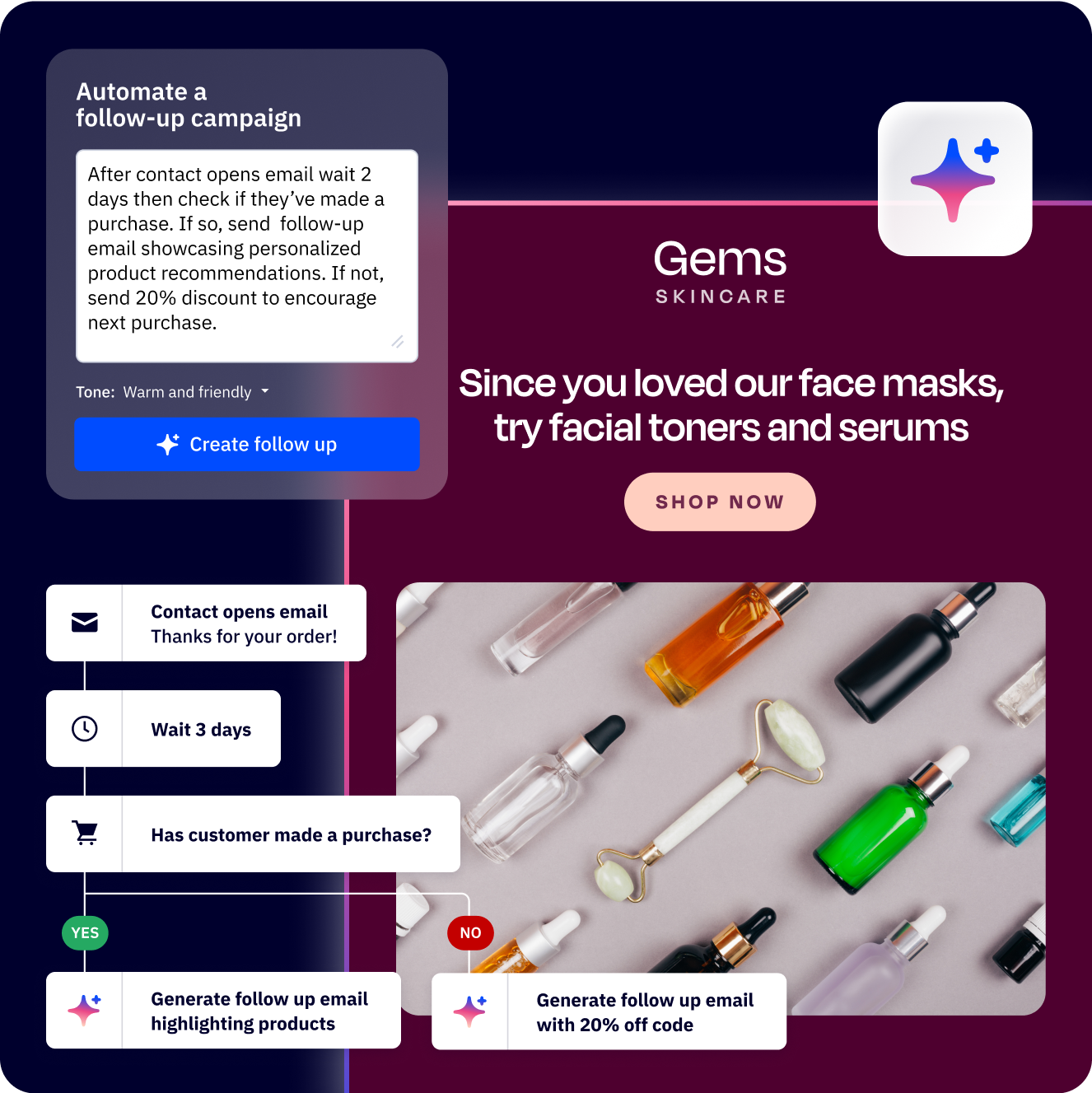
ActiveCampaign's automation builder — unlimited steps, branching logic, and AI-generated workflows from a plain-language description.
When we looked at ActiveCampaign's feature set across the same price range, the contrast is stark. Even on the Starter plan at $15/month, you get unlimited automation steps, up to five triggers per automation, branching logic (if/then conditions, percentage splits, date-based, goal-based), and the ability to automate across email, SMS, and transactional messages simultaneously. That's not an enterprise feature — that's the entry point.
What makes this really significant is the depth of triggers. ActiveCampaign supports 75+ native triggers based on contact behavior, account activity, and deal status. Mailchimp supports fewer than 35, and they're contact-only. In practice, this means ActiveCampaign can fire automations based on specific website visits, purchase history, lead scores, deal stage changes, and custom events while Mailchimp is largely limited to email engagement signals.
| Feature | ActiveCampaign | Mailchimp |
|---|---|---|
| Automation steps | Unlimited | Up to 4 (Essentials), 200 on higher plans |
| Native triggers | 75+ (contact, account, deal) | <35 (contact-only) |
| Pre-built automation templates | 900+ | ~100 |
| Multi-channel automation | Email, SMS, WhatsApp, site messages | Email only (SMS via third-party) |
| AI automation builder | Yes — describe in plain language | No |
| Automation visualization map | Yes | No |
"It blew my mind that I could have an automation just to do the task of updating a custom field with the last time that somebody opened an email or clicked on a link."— Matt Giovanisc, Swim University
The Double-Billing Problem
This one catches people off guard. Mailchimp charges you based on subscribers but, if the same contact appears on three different lists, you're billed for them three times. For businesses that segment by product interest, geography, or customer status, this can quietly inflate your list costs by 2x or 3x without you even noticing until the invoice arrives.
ActiveCampaign charges once per unique contact, regardless of how many lists, tags, or segments they belong to. This isn't a minor convenience — it's a fundamentally different pricing model that becomes more significant the more sophisticated your segmentation gets.
Mailchimp has also quietly shrunk its free plan three times over the years starting from 2,000 contacts, then down to 500, and now down to just 250 today all while removing automation workflows, email scheduling, and A/B testing from the free tier along the way. The paid plans have also removed features that used to be standard, like the Creative Assistant and Content Optimizer, as Mailchimp consolidates its AI under the "Intuit Assist" umbrella following its $12 billion acquisition by Intuit.
AI That Actually Does the Work vs. AI That Helps a Little
Of all the areas on which we compared these two platforms, the AI gap is where things have moved fastest in 2026 and it's not even close.
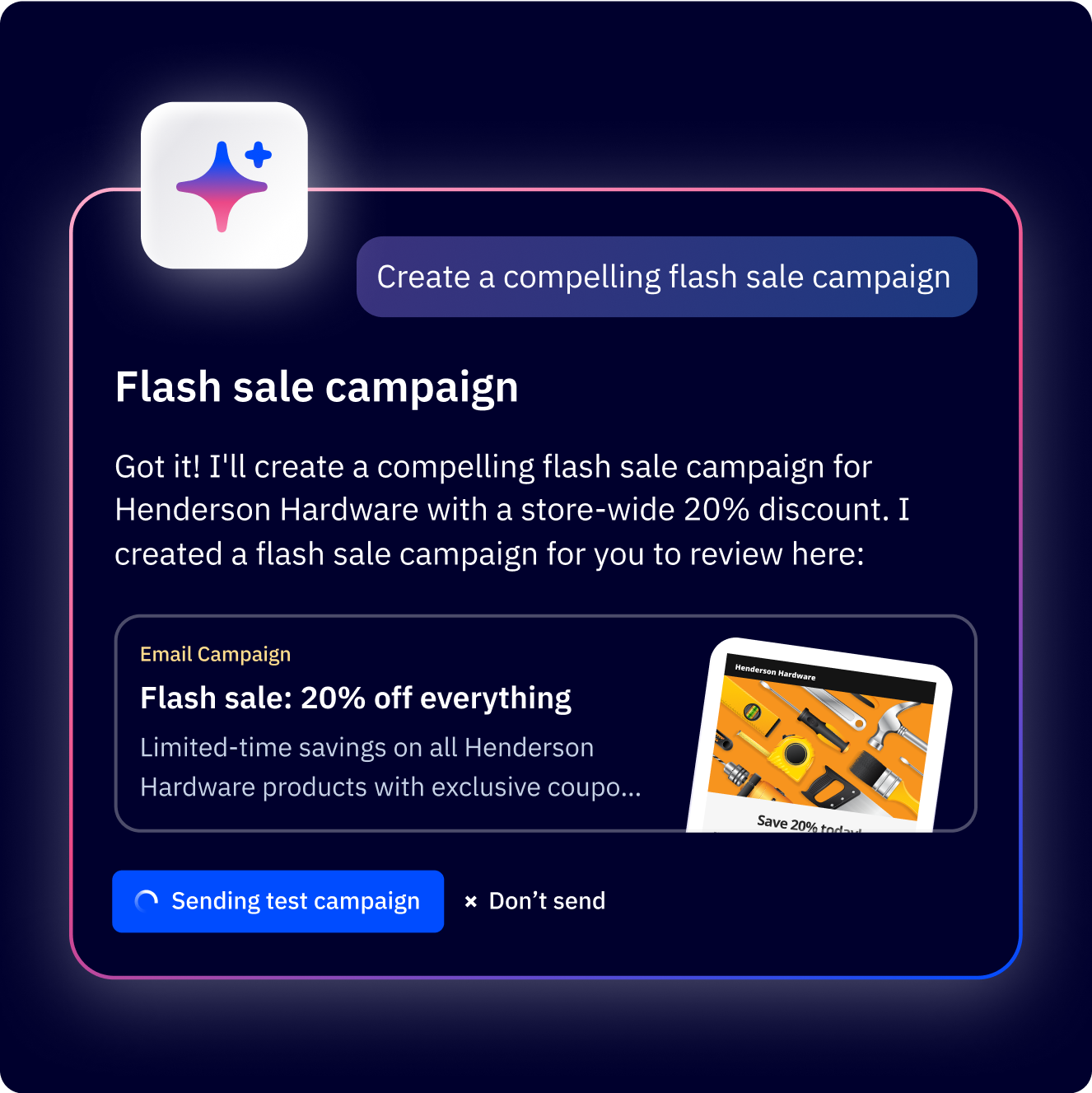
Type "Create a compelling flash sale campaign" and ActiveCampaign's AI Campaign Builder generates a complete, ready-to-review email with subject line, body copy, visuals, and all.
ActiveCampaign's AI layer is called Active Intelligence, and it runs through the entire platform rather than being bolted on as a feature add-on. The most compelling piece for us is the AI Campaign Builder where you type what you want in plain language (ie. "Create a compelling flash sale campaign" or "Build a re-engagement sequence for contacts who haven't opened in 90 days", etc.), and it generates a complete, ready-to-review campaign. Not just a subject line suggestion. An entire campaign.
On top of that, Predictive Sending analyzes each individual contact's engagement history and sends at the optimal time for that specific person and not just a best-guess average for your whole list. This alone has been shown to improve click-through rates by 17%. AI-Suggested Segments surface high-value audiences you might not have thought to build yourself. The AI Brand Kit imports your colors, fonts, and logos from your website URL and applies them to templates automatically. And if you're marketing internationally, AI Translation converts campaigns into 75+ languages based on each contact's preference.
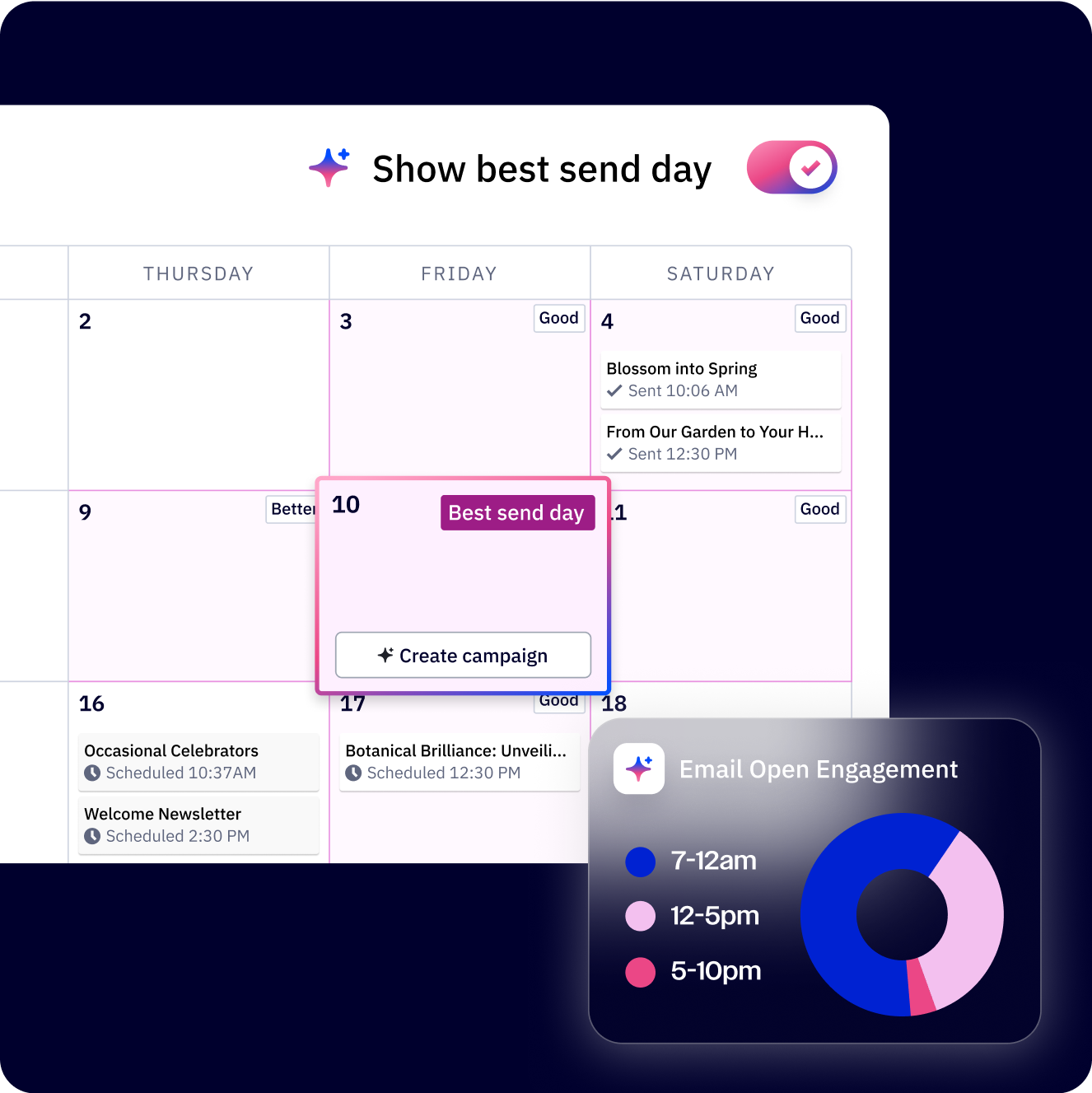
The AI Campaign Calendar highlights the best send days for your audience based on historical engagement data — a feature Mailchimp doesn't offer at this level.
Mailchimp also has AI features under the "Intuit Assist" branding but independent analysis has noted that several of the platform's AI design tools were quietly retired or demoted following the Intuit acquisition. What remains is primarily content suggestions, basic automation generation for welcome and cart abandonment flows, and a send time optimization feature that operates at the list level rather than per contact. That last distinction matters: personalizing send time across your entire list is meaningfully different from personalizing it for each individual.
Pricing: It's More Competitive Than You'd Think
One of the most common misconceptions we've encountered is that ActiveCampaign costs significantly more than Mailchimp. At the entry level, ActiveCampaign actually costs less than MailChimp and, at the advanced level, it's much less.
| Plan (1,000 contacts) | ActiveCampaign | Mailchimp |
|---|---|---|
| Entry-level paid | Starter: $15/mo Unlimited automation, CRM, AI features |
Essentials: $26.50/mo Basic automation (4 steps max) |
| Mid-tier | Plus: $49/mo Landing pages, unlimited actions, AI content |
Standard: $45/mo AI features, dynamic content, custom reporting |
| Advanced | Pro: $79/mo Predictive sending, attribution, conditional content |
Premium: $350/mo Advanced testing, priority support |
| Free trial | 14 days, no credit card | Free plan: 250 contacts only, features stripped |
| Free onboarding | Yes, on Plus and Pro plans | Never free on any plan |
| Contact counting | Once per unique contact | Per subscriber per list |
Where the pricing gap becomes dramatic is at the higher end. If you compare what you'd need from HubSpot, another popular marketing automation platform, to get comparable automation depth you'd need to spend roughly $800/month for their Pro tier so ActiveCampaign's Pro at $79/month is genuinely serving a different market. But even Mailchimp's Premium at $350/month for 1,000 contacts versus ActiveCampaign's Pro at $79/month for the same list size is a significant difference to the typical small business for comparable feature depth.
WhatsApp: A Channel Mailchimp Simply Doesn't Have
This surprised us when we dug into it. WhatsApp has over 3 billion monthly active users and message open rates around 98%. It's arguably the highest-attention marketing channel available right now. ActiveCampaign is an official WhatsApp Business Solution Provider which enables you to trigger WhatsApp messages as part of automated workflows, capture CRM data from conversations, and run sequences that combine email, SMS, and WhatsApp in a single workflow.
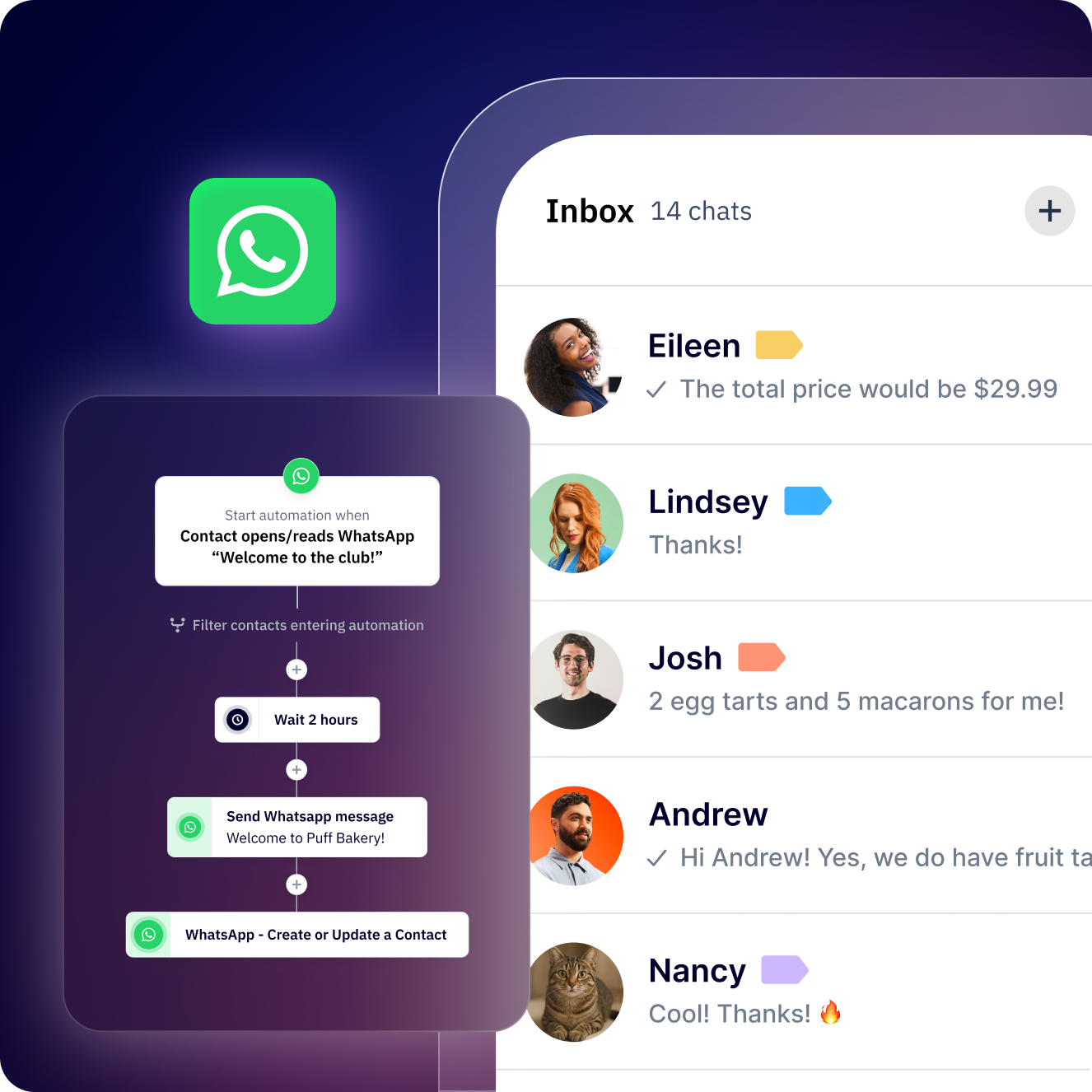
ActiveCampaign's WhatsApp automation triggers messages based on contact behavior, manages conversations in a unified inbox, and updates CRM records automatically.
Mailchimp has no WhatsApp capabilities. If you're marketing internationally or to audiences where WhatsApp is the primary communication channel, this isn't a nice-to-have feature gap — it's a fundamental limitation of your ability to reach your target audience.
What Real Customers Say After Switching
When we went through all 26 customer stories ActiveCampaign has published from businesses that previously used Mailchimp, a few themes emerged consistently. Deliverability came up most often as the immediate trigger. But the longer-term value cited most was the automation depth — the ability to build marketing sequences that respond to what individual contacts actually do, not just what list they're on.
"ActiveCampaign's automation features have significantly eased my workload — comparable to adding one or two full-time employees to the team."— Meagan Ingersoll, Marketing Director, Palmetto Fortis
"ActiveCampaign allows us to personalize communications and scenarios well. The platform is user-friendly and allows us to put CRM at the heart of every team's preoccupation, not only the marketing team."— Estelle Schuster, Head of Acquisition, FoodChéri
"ActiveCampaign has functionality that I wouldn't expect at this price point and some I haven't seen at much higher prices."— Together For Safer Roads
FoodChéri's result of an incredible 65x more email outreach is the one that sticks with us most. That's not a 65% improvement. That's a 65 times or 6,500% improvement! The context matters: they had significant automation capabilities unlocked that simply weren't available at their Mailchimp tier. When the ceiling lifts, the scale of what's possible changes completely.
Migrating: Easier Than You Might Expect
One of the most common reasons businesses stay on a platform they've outgrown is the perceived pain of migration. We looked into what switching from Mailchimp to ActiveCampaign actually involves, and it's meaningfully easier than most people assume.
ActiveCampaign has a Migration Agent which serves as an in-app tool that pulls your Mailchimp data (contacts, audiences, campaigns, templates, automations, and forms) into ActiveCampaign automatically. No CSV exports, no manual field mapping. You enter your Mailchimp API key, review what it finds, and start the migration. Most migrations reportedly complete in under two hours. For qualifying plans (Plus and Pro), a dedicated onboarding specialist is included at no additional cost and the results-in-30-days-or-money-back guarantee means there's effectively no risk in trying.
Compare that to Mailchimp's approach: migration help is only available on their Premium plan ($350/month), and their migration service for moving to ActiveCampaign would cost you extra on top of that. The asymmetry is pretty telling.
Where Mailchimp Still Has an Edge
In the spirit of being genuinely useful rather than just promotional, here's where Mailchimp legitimately wins. If you want to get a campaign out the door in 20 minutes with zero learning curve, Mailchimp's drag-and-drop editor and streamlined campaign creation flow is arguably faster. The UI is familiar to a lot of people, and for simple newsletter sends, that familiarity has value.
Mailchimp also has better brand recognition, which occasionally matters when you're integrating with third-party tools since some older integrations were built against Mailchimp specifically. And if you genuinely only need to send occasional announcements to a small list with no automation ambitions, the economics favor Mailchimp's simpler pricing model.
But those use cases are narrow, and they tend to get narrower as businesses grow. The pattern we've seen consistently is that businesses start on Mailchimp because it's easy, hit a wall somewhere between 1,000 and 5,000 contacts, and face the same decision: pay more for features within Mailchimp's tiered structure, or move to a platform purpose-built for the kind of marketing they actually want to do.
Our Take
We've looked at a lot of email and marketing automation platforms on this site, and the honest summary is this: ActiveCampaign is the better platform for most businesses that are serious about email marketing in 2026. The deliverability lead is real, independently verified, and consequential. The automation depth is genuinely different, not just marginally better. The AI features aren't simple window dressing. The AI Campaign Builder and Predictive Sending are tools that actually save time, improve results, and drive revenue back to the bottom-line in ways we can measure.
What surprises people most when they actually make the switch is that it wasn't as complicated as they feared, and the results showed up faster than they expected. Over 100 businesses switch from Mailchimp to ActiveCampaign every month. That's a strong signal.
If you're on Mailchimp and you're happy with what you're getting, there's no reason to change for the sake of it. But if you've ever felt like your marketing could be doing more, if you're manually doing things that should be automated, or you're not sure your emails are actually getting delivered, ActiveCampaign's 14-day free trial is the lowest-friction way to find out what you've been missing. No credit card required, and if you decide to move forward, the 30-day money-back guarantee means there's essentially no downside to trying.
Disclosure: This article contains affiliate links. See our affiliate policy for details.