The Problem That Autonomous Marketing Is Trying to Solve
To understand what autonomous marketing is, it helps to be honest about what regular marketing automation isn't. Most marketing automation platforms, including many excellent ones, are fundamentally execution engines. You design the workflow, define the triggers, write the content, set the timing, build the segments, and test the variations. The platform runs what you tell it to run. When it works well, it's genuinely powerful. But the key word is "when" because every single piece of logic has to come from you.
The result is that even with sophisticated automation in place, most marketing teams spend the majority of their time on execution rather than strategy. According to ActiveCampaign's own research, which aligns with what we hear anecdotally from marketers we talk to, the average marketing professional loses around 13 hours every week to repetitive execution tasks that could theoretically be handled automatically. That's nearly two full working days, every week, not spent on the creative and strategic work that actually requires human judgment.
Autonomous marketing is an attempt to close that gap, not just by automating the execution of workflows you've already designed, but by having AI take on the design, optimization, and decision-making work itself. You set the goals. The AI figures out how to reach them.
Automation vs. Autonomous: What's Actually Different
We find the clearest way to explain this is with a concrete example. Imagine you want to increase repeat purchases from existing customers.
Traditional automation
- You define the segment manually (customers who purchased 30+ days ago)
- You write three email variations
- You build the if/then workflow logic
- You set send times based on your best guess
- You check results a week later and adjust manually
- You repeat this process for every new campaign goal
Autonomous marketing
- You tell the platform "increase repeat purchases"
- AI identifies the right audience segments automatically
- AI generates the campaign content and workflow
- AI optimizes send times per individual contact
- AI monitors results and adjusts in real time
- AI suggests what to do next based on what worked
The difference isn't cosmetic. In the automation model, every piece of marketing logic is a human decision that has to be made, documented, built, and maintained. In the autonomous model, you're delegating the decision-making to the AI so your job effectively shifts from building the machine to setting the direction and reviewing the output.
This is why we think ActiveCampaign's framing is genuinely useful. They're not just adding an AI assistant that helps you write email subject lines. They're arguing, and the platform increasingly demonstrates, that the AI can handle the full marketing execution loop from strategy, through execution, through optimization, with humans staying in a supervisory and creative role.
Active Intelligence: The Engine Behind It
ActiveCampaign calls its AI layer Active Intelligence, and one of the things that distinguishes it from competitors' AI features is that it's designed to run through the entire platform rather than being isolated in specific tools. It's trained on billions of customer interactions and marketing data points, which gives it a level of domain-specific context that general-purpose AI models don't have.

Active Intelligence isn't a single feature — it's a layer that runs through every part of the ActiveCampaign platform, from campaign creation to analytics to next-step recommendations.
ActiveCampaign organizes Active Intelligence around three core functions they call Imagine, Activate, and Validate. We think this framework is actually a useful way to understand what the AI does at each stage of the marketing process.
Imagine
Goal-setting in plain language. Describe what you want to achieve and AI builds the strategy, workflow, and content to pursue it. Replaces manual workflow engineering.
Activate
Predictive intelligence that flags problems before they become failures and creates opportunities proactively. Replaces reactive dashboard-watching and guesswork.
Validate
Scalable personalization across every channel. Every piece of customer data becomes immediately actionable — AI creates personalized experiences at a scale no team could manage manually.
The AI Agents: What Each One Actually Does
Within Active Intelligence, ActiveCampaign has built out a library of what they call AI Agents which are discrete capabilities that each handle a specific part of the marketing workflow. When we went through them in detail, we were struck by how complete the coverage is. This isn't a handful of AI features bolted onto an existing platform — it's an attempt to have AI coverage across every step of the marketing process.
AI Campaign Builder
This is the one that tends to get the most attention, and it earns it. The Campaign Builder lets you describe a campaign in plain language such as, "create a re-engagement email for customers who haven't purchased in 60 days" or "build a flash sale campaign for our hardware line", and it generates a complete, ready-to-review campaign; and I'm not talking about just a subject line or a content outline, but a full campaign with email copy, design, segmentation, and send configuration.
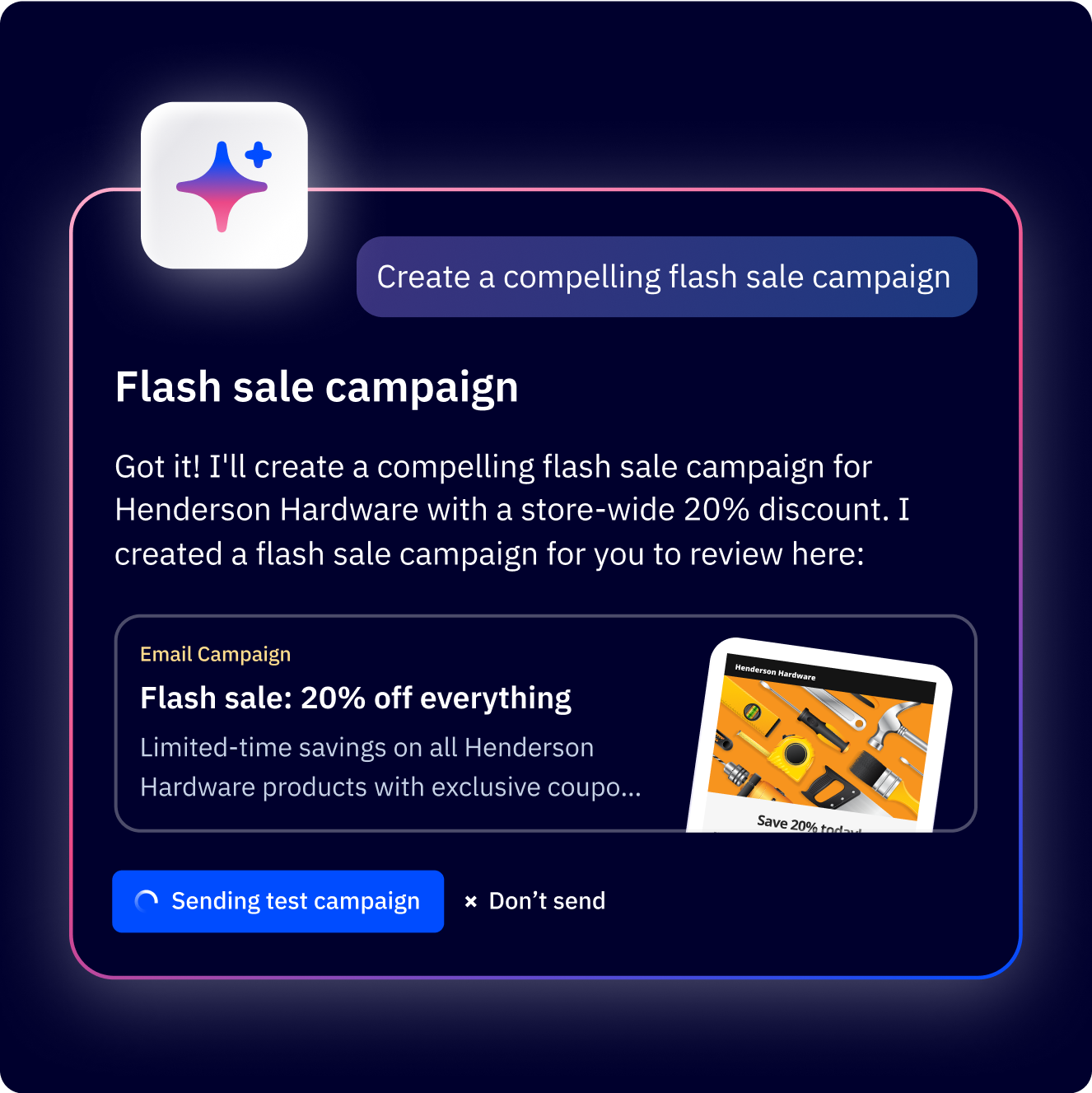
Type a plain-language description of what you want and the AI Campaign Builder returns a complete campaign including subject line, body copy, visuals, and send configuration all ready for your review.
What matters here isn't just the speed, although cutting campaign creation from hours to minutes is genuinely significant and alone can be a game-changer for some. What's most valuable, in our opinion, is that the AI is drawing on marketing best practices and performance data to build the campaign and not just following a template so the output itself is optimized and not generic.
AI Automation Builder
The same plain-language approach applied to workflow creation. Describe the automation you need and the AI builds it including branching logic, timing, triggers, and all. For marketing teams that currently spend hours mapping out automation flows in visual builders, this is a substantial time reduction.
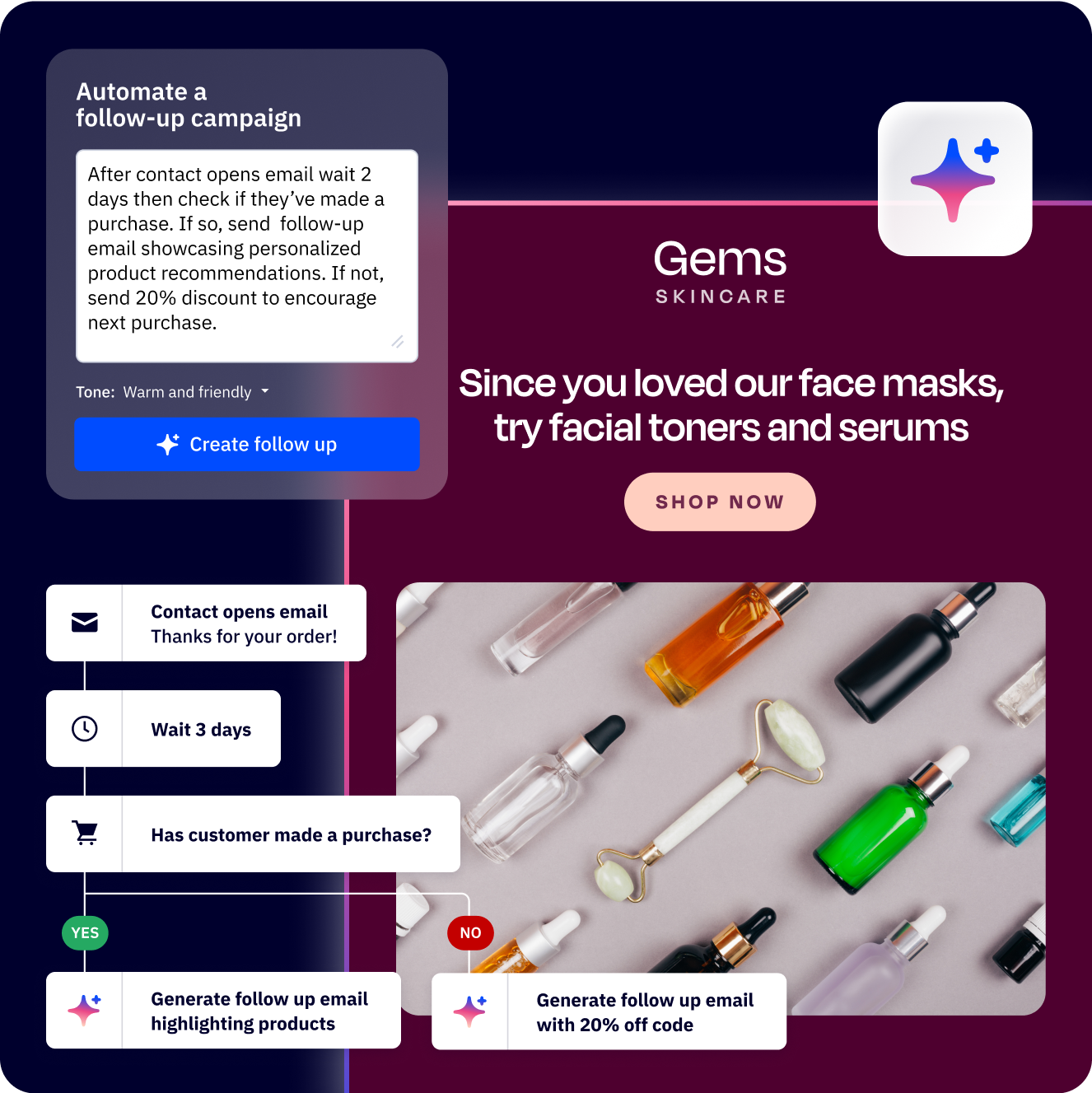
The AI Automation Builder constructs multi-step workflows from a plain-language description including branching logic, triggers, and timing that would take an experienced marketer hours to build manually.
Predictive Sending
Most email platforms offer "send time optimization" that suggests a good time to send based on aggregate list data. Predictive Sending is different as it analyzes each individual contact's historical engagement patterns and delivers at the optimal moment for that specific person. The difference between list-level and contact-level optimization is significant in practice: ActiveCampaign reports a 17% improvement in click-through rates for campaigns using Predictive Sending. Over a year of campaigns, that's a compounding advantage that adds up fast.
AI-Suggested Segments
One of the subtler but genuinely useful features. Rather than requiring you to define segments from scratch, the AI analyzes your contact database and surfaces high-value audience groups you might not have thought to target such as repeat buyers, contacts showing purchase intent, at-risk customers based on engagement decline, and similar patterns that require looking across multiple data dimensions simultaneously.
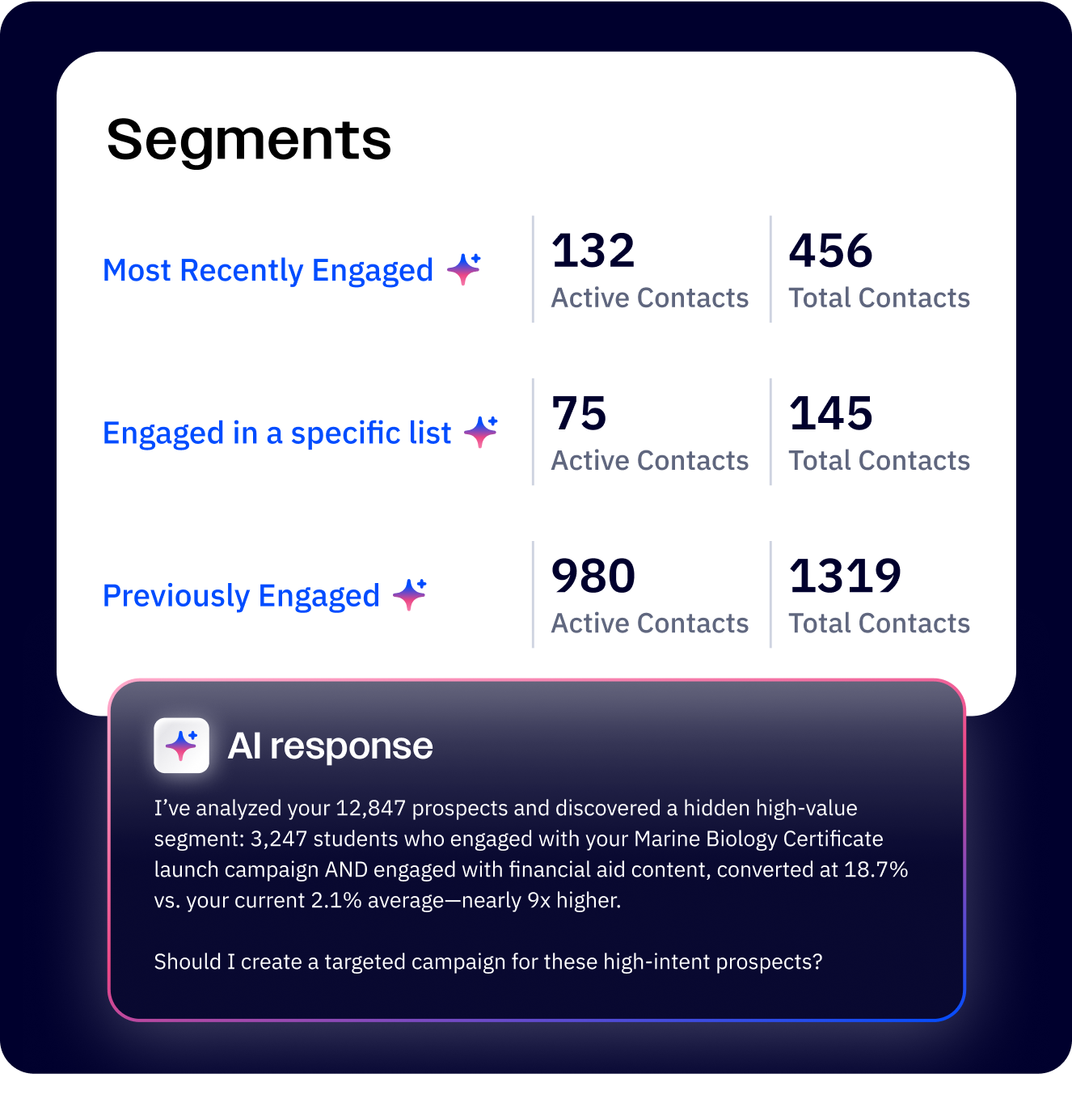
AI-Suggested Segments surfaces high-value audiences automatically by identifying patterns across your contact database that would take a human analyst significant time to find manually.
Business Goals & Next-Best-Action Cards
This is perhaps the clearest expression of what "autonomous" means in practice. Rather than asking "how did my last campaign perform?", you set a business goal such as increase form submissions, drive customer engagement, or recover at-risk accounts and the platform tracks your progress against it in real time, surfacing what's working and what to do next.
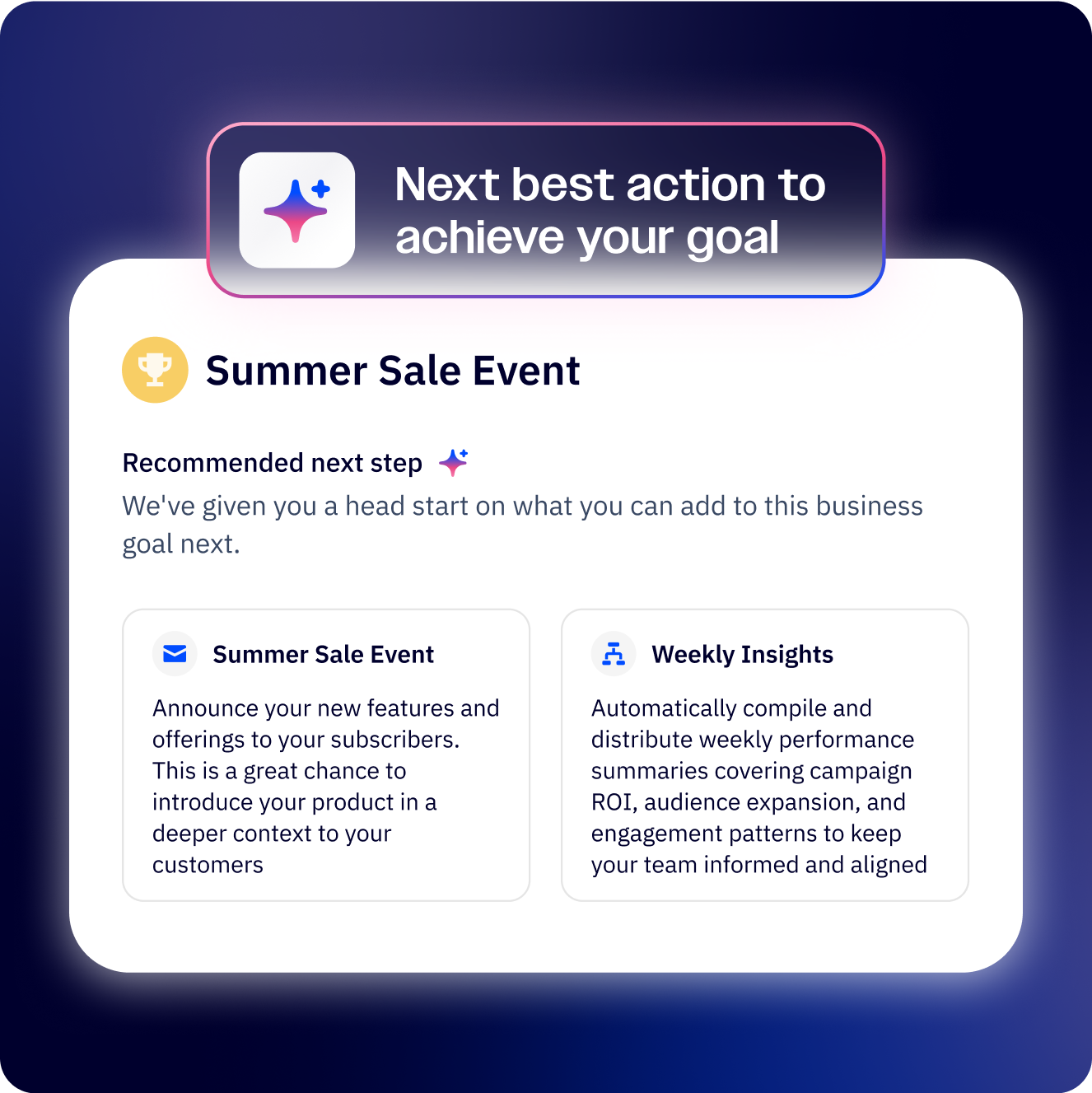
Set a business goal and Active Intelligence tracks your progress in real time to identify what's working, what isn't, and what action to take next.
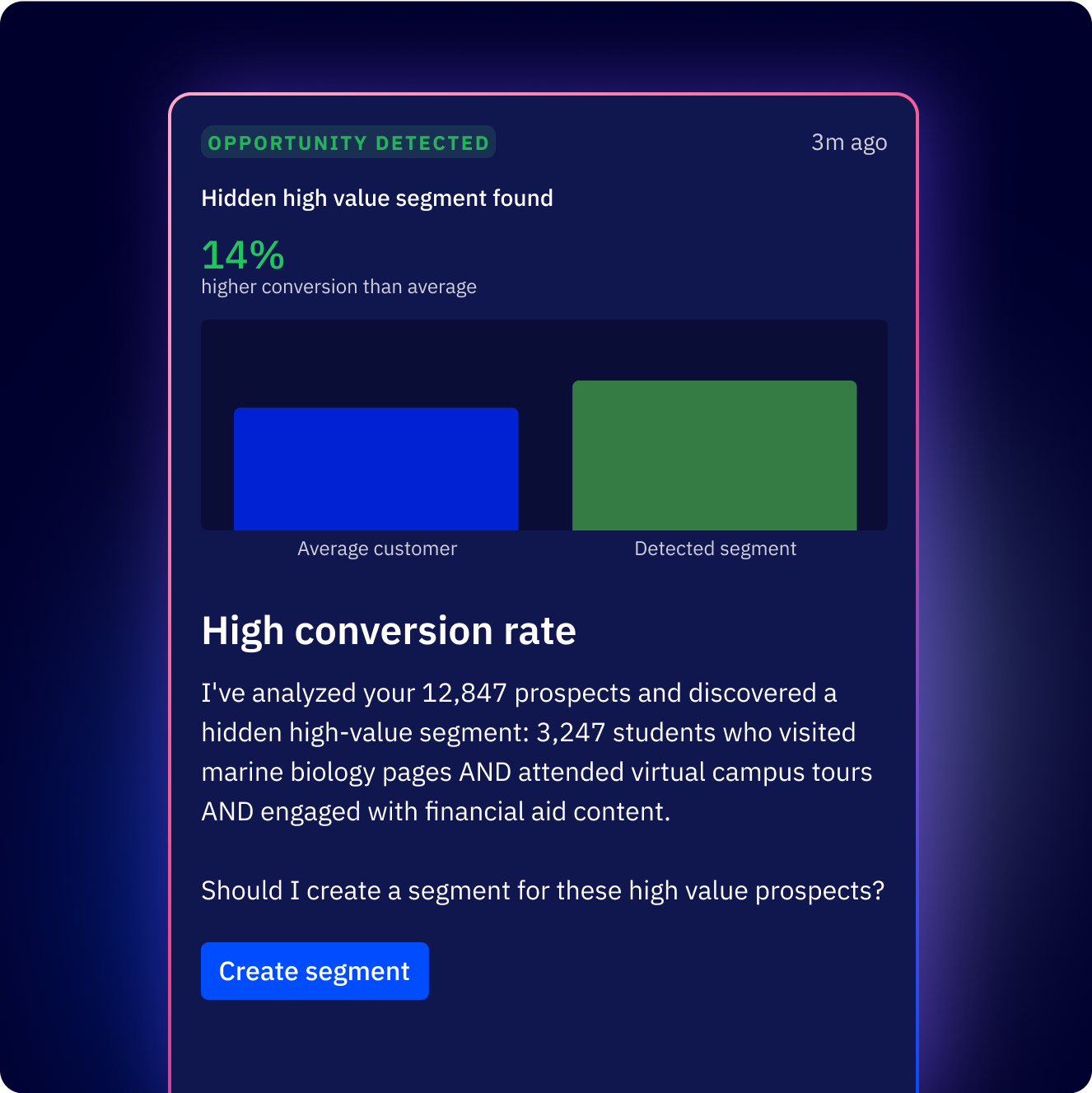
Next-Best-Action Cards surface AI-generated recommendations based on your current performance data so you always know what to work on next rather than staring at a dashboard trying to interpret raw metrics.
The Next-Best-Action Cards are a natural extension of this: rather than leaving you to stare at a dashboard and figure out what to act on, the AI surfaces specific recommended actions based on current performance. It's a subtle but important shift — from reporting (here's what happened) to guidance (here's what to do about it).
AI Brand Kit
A practical feature that often gets overlooked in favour of the flashier capabilities. You point Active Intelligence at your website URL and it imports your brand identity including colours, fonts, logos, and visual style and then applies them automatically to email templates. For businesses that have previously spent hours making templates match their brand guidelines, this alone is a meaningful time saving.
AI Translation
One campaign, 75+ languages, each delivered in the contact's preferred language. This isn't a separate workflow. It runs within existing campaigns and translates subject lines, body text, and CTAs automatically based on each contact's language preference. For any business with an international audience, this capability essentially removes a significant barrier to personalised multilingual marketing.
Who Benefits Most
We've thought about this question carefully, because "autonomous marketing" can sound like a solution looking for a problem if you're already running a fairly lean, effective email operation. Based on everything we've seen, the businesses that get the most out of Active Intelligence tend to fall into a few categories.
Small business owners and solo marketers are arguably the biggest beneficiaries. The challenge for a one-person marketing operation has never been strategy — it's been bandwidth. When one person is responsible for email, social, content, and everything else, the manual execution overhead of traditional automation is genuinely crushing. Autonomous marketing effectively gives a solo operator the output capacity of a team.
Growing companies that have outpaced their marketing infrastructure are another strong fit. There's a common inflection point where a business has enough contacts and revenue complexity to need sophisticated marketing automation, but hasn't yet hired the team to build and maintain it. Active Intelligence lets companies punch above their weight at that stage by enabling them to run and manage personalized and optimized, behavior-driven marketing without the expensive headcount.
Marketing teams that are stuck in execution mode, where most of the team's time goes to building and managing campaigns rather than strategy and creative, also tend to see dramatic results. When the AI handles the execution layer, the team's time gets redirected to the work that actually requires human creativity and judgment.
What the Results Look Like in Practice
We've been through a significant number of ActiveCampaign customer stories as part of our research, and a few stuck with us as particularly illustrative of what autonomous marketing actually produces.
"As we were growing, it became almost impossible to manage communication and growth manually. That's when we realized we needed automation, and that's where ActiveCampaign came in. 66% of revenue year on year is likely driven by ActiveCampaign automation."— Manab Boruah, Product Marketing Manager, Kommunicate
Kommunicate's result is striking not just for the revenue attribution — it's the scale of it. When two-thirds of your recurring revenue can be traced back to automated marketing flows, that's not a feature you're using. That's a fundamental piece of your business infrastructure.
"We're tracking trials started and trial conversions, and right now we're converting at over 20%. Before ActiveCampaign, we were converting less than 10%. ActiveCampaign has doubled our conversion rate."— Nathan Monk, Co-Founder, Motrain
"Since implementing ActiveCampaign, our deliverability rate is 99.88%, our open rate is 43.7% (which has doubled since 2021), and our click rate is 5.56% (up from 1.18% in 2021)."— MentorShow (via ActiveCampaign case study)
MentorShow's metrics are worth dwelling on for a moment. A click rate of 5.56% against an industry average that typically sits below 3% is exceptional — and the trajectory from 1.18% represents more than incremental improvement. That's the kind of shift that happens when send timing, segmentation, and content personalization are all working together intelligently rather than being configured in isolation.
The Honest Caveats
We'd be doing you a disservice if we presented autonomous marketing as a no-configuration magic solution, so a few honest notes.
First, the AI is only as good as the data it has to work with. If your contact database is messy, your tagging is inconsistent, or your historical campaign data is thin, the AI's recommendations and automation outputs will reflect that. The platform rewards good data hygiene, and businesses that invest time cleaning up their contact data before leaning into AI features see materially better results.
Second, "autonomous" doesn't mean "unsupervised." The best results we've seen come from teams that treat the AI as a very capable collaborator by carefully reviewing what it produces, bringing their own brand voice and customer & business knowledge to bear, and iterating until it's "right". Fully hands-off approaches tend to produce competent but generic output. The AI handles execution; humans still own the strategy and the voice.
Third, there's a learning curve that's by no means steep, but it is very real. Getting the most out of Active Intelligence means understanding what goals to set, how to interpret next-best-action recommendations, and when to override the AI's suggestions. ActiveCampaign provides good onboarding support for this, but it's worth setting aside time to learn the system properly rather than treating it as plug-and-play.
Our Assessment
We cover a lot of AI tools on this site, and one of the patterns we've noticed is that "AI-powered" is often applied to features that are, in reality, quite modest like a content suggestion here, a subject line generator there. What ActiveCampaign has built with Active Intelligence is meaningfully more ambitious and productive than that. The goal-setting-to-execution loop, the contact-level personalization at scale, the next-best-action guidance, etc. aren't simple feature additions to a traditional platform. They represent a genuine attempt to change the relationship between a marketing team and their tools.
Whether autonomous marketing lives up to its full potential depends considerably on how a business implements it. But based on the customer results we've looked at, the independent performance data, and our own examination of the platform, we think ActiveCampaign is making a credible case that this is where serious marketing technology is heading; and that they're currently leading the field in bringing it to small and mid-sized businesses at an accessible price point.
If you want to see what Active Intelligence actually looks like in practice before committing, ActiveCampaign's 14-day free trial gives you full access to the platform with no credit card required. Given the 30-day money-back guarantee on paid plans, it's about the lowest-risk way we can think of to find out whether autonomous marketing changes how your team operates.
Disclosure: This article contains affiliate links. See our full affiliate policy.